Menu
Basilica of Svatá Hora
The origins of Svatá Hora date back to the 13th to 15th centuries. In the 17th century, the Italian architect Carlo Lurago created a design under which the Jesuits built the Marian sanctuary. In the 18th century, the most significant architect of that time, Kryštof Dientzenhofer, contributed to the completion of the structure.
In 1861, the Redemptorists (Congregation of the Most Holy Redeemer) took over the administration of Svatá Hora, serving there until 1950. In 1903, they repaired the church and covered its oldest section, which was still undecorated, with new figurative and ornamental stucco decoration. After extensive renovation, they requested Pope Pius X to grant the title of "basilica" to the pilgrimage church, a title by which the Pope exceptionally elevates or honors the most famous temples. Pius X recognized the Redemptorists' request as justified and issued a special breve, "Sacris aedibus," elevating Svatá Hora to "basilica minor" in 1905. https://svata-hora.cz/en/
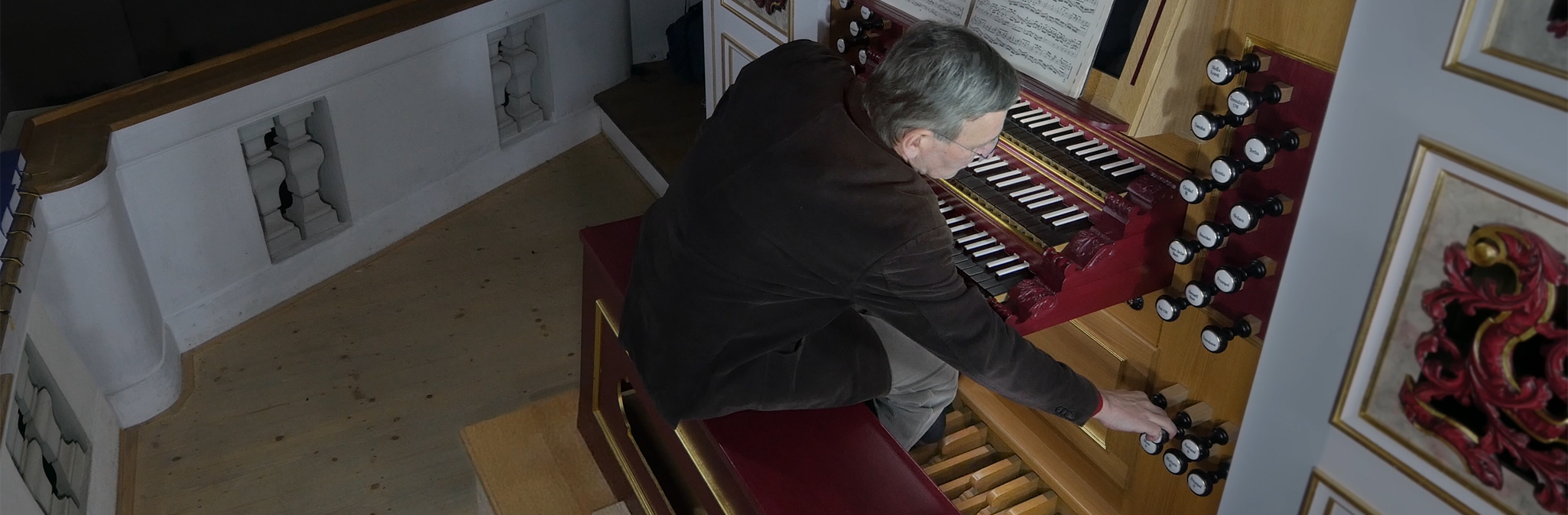
The Great Organ at Svatá Hora
The National Cultural Monument Svatá Hora in Příbram, Central Bohemia, is rightfully called a Marian Baroque pearl in the heart of Bohemia. It was built in the mid-17th century according to the plans of the renowned Italian architect Carlo Lurago. Those who visit the Basilica of the Assumption of the Virgin Mary at Svatá Hora during a mass or concert will have the opportunity to hear the sound of the unique new organ, constructed between 2009 and 2018.
Building the organ was a challenging task, as the space for the organ in the basilica is small and intricate. Therefore, the builder, Vladimír Šlajch, had to choose various unconventional solutions. Nevertheless, he managed to create a unique instrument that is even more valuable because it was mainly funded by voluntary donations.
The project was initiated by the civic association Matice Svatohorská, which collected voluntary contributions for ten years. The city of Příbram also contributed financially. The lengthy process involved not only financing but primarily the construction itself.
Vladimír Šlajch aimed to integrate the organ acoustically and aesthetically into the basilica's space as seamlessly as possible. As a result, it now appears as if the organ has always been part of the basilica. It features a beautiful white gilded case, which, although newly created, perfectly matches the overall character of the basilica.
Vladimír Šlajch aimed to integrate the organ acoustically and aesthetically into the basilica's space as seamlessly as possible. As a result, it now appears as if the organ has always been part of the basilica. It features a beautiful white gilded case, which, although newly created, perfectly matches the overall character of the basilica.
The western wall of the basilica is divided into three separate sections, which consist of tall windows placed at varying heights. The organ case has an unusually narrow base and continues with a wide bridge that houses the largest parts of the instrument, culminating in a crowning mechanism at the top. Due to the small and confined space of the basilica, some parts of the organ are also placed in side niches that were created in the 1940s.
Pipes fill every available space in the choir. In the side spaces, there are pedal pipes. When listening to the organ, its sound surrounds you due to this intricate arrangement. The organ has three manuals and thirty-three speaking registers. Many of the registers were intentionally chosen to allow for performances in various colors at softer dynamics. In addition to standard registers, you can hear a unique feature of Svatá Hora – two "Zimbelstern" (cymbal stars). These are registers that, when pulled, set two beautiful golden stars in motion, mirroring the star of the main altar. Behind each star are small bells that ring as they move, sounding like golden stars falling straight from the sky. Another rarity is the pedal register Trombone, a voice register that simulates the human voice.
Markéta Vejvodová
source: Czech Radio
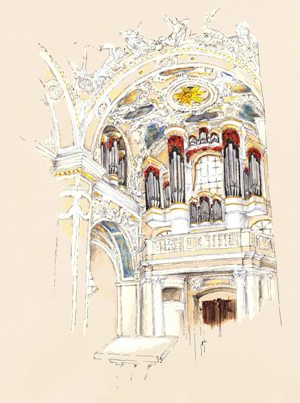
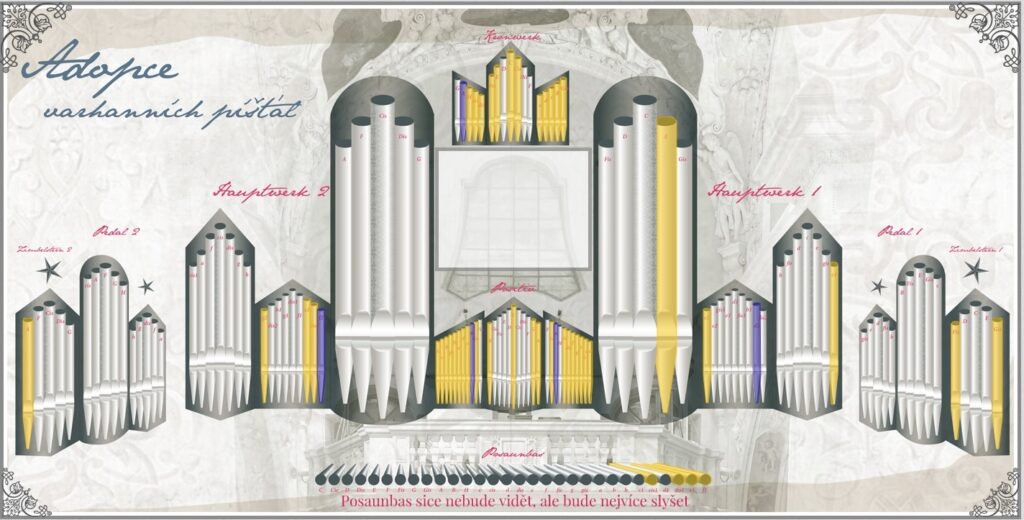
Specifications of Vladimír Šlajch's Organ at Svatá Hora in Příbram
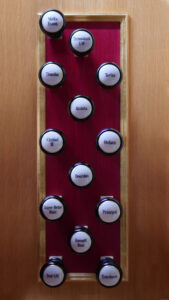
2. Manual
Hauptwerk HW (C–f3)
Principal 8′
Bifara 8′ (c1–f3)
Bourdon 8′
Quintadena 8′
Octava 4′
Violeta 4′
Quinta 3′
Nassat 3′
Super Octava 2′
Quinta Minor
Tertia
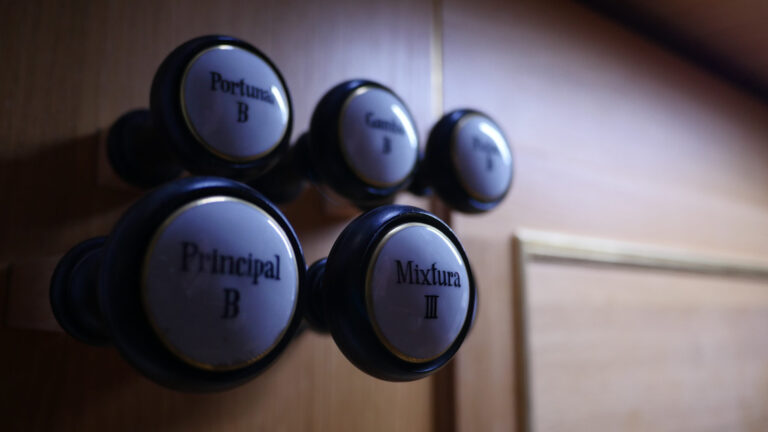
Mixtura 3x
Cimbal 3x
Tromba 8′
Pos/HW
UW/HW
3. manuals
Positiv Pos (C–f3)
Copula Major 8′
Flauta Minor 4′
Principal 2′
Flauto Soprano 2′
Sedecima 1′
Mixtura 2x
Vox Humana 8′
Tremulant
1. manuals
Unterwerk UW(C–f3)
Portunal 8′
Gamba 8′
Principal 4′
Fugara 4′
Mixtura 2–3x
Oboe 8′
Tremulant
Pedal
Ped (C–f1)
Sub Bass 16′
Principal Bass 8′
Octav Bass 8′
Superoctav Bass 4′
Kornett Bass 4′ 3x
Trombone 16′
UW/Ped
HW/Ped
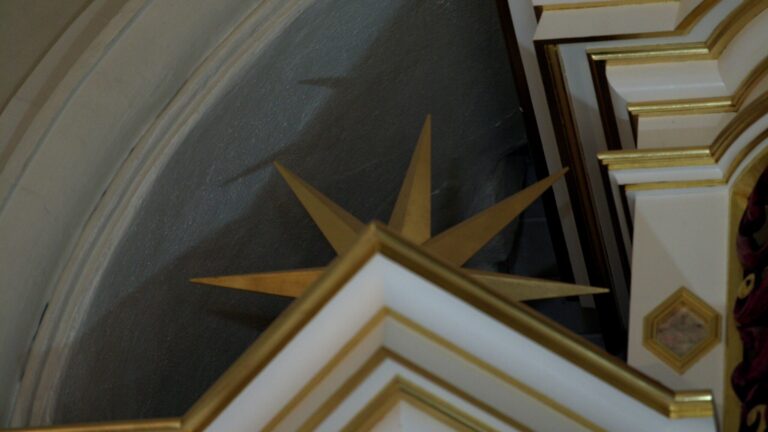
Zimbelstern, evangelical side
Zimbelstern, epistolary page
 English
 Czech